


Luxury Arctic Lodge in Canada: What to Expect (Raphaelle’s Travel Story)
Five days at Ungava Polar Eco-Tours in Nunavik, Québec. No roads, no signal, no idea what I was getting into.
My name is Raphaëlle Godbout. I’m a wildlife photographer from Québec, and in September 2024 I flew up to Ungava Bay for five days at a camp I’d never heard of, in a part of my own province I’d never set foot in.
I’ve worked in remote places before and I’ve taken small planes into wilder corners of Colombia and Chile but nothing prepared me for what landing on the Ungava coast actually feels like. This is what five days at a luxury arctic lodge in Canada really looked like, from someone who walked in skeptical of the word luxury being used hundreds of miles from the nearest community.
How I Prepared for My Trip
The first thing anyone told me about Nunavik was: bring more warm and windproof clothes than you think you need. Even in September, when southern Québec is still hanging on to summer, the Ungava coast is firmly ahead into autumn. I made sure to pack :
- Windproof shell
- windproof pants
- fleece base layers
- scarves
- a wool tuque
- gloves (not mittens)
- hiking boots
- warm socks
- sunglasses (mostly to block the wind in my eyes)
The weather flips fast: it can drizzle in the morning, blow hard in the afternoon, and clear into a hard sun by evening. You want to be ready to add or shed a layer in a few minutes.
And of course, as a photographer, my camera gear came along too, which was more a question of where to put it than how to protect it. A duffel bag worked better than a hard-sided rolling suitcase. There are no paved paths up there.
But if you do bring large suitcases, you’ll be happy to know that Ungava Polar Eco-Tour’s staff will be available to carry all of your belongings in an ATV.


Getting to Nunavik, Ungava Bay
The Journey Is Part of the Experience
Nunavik is the northern third of Québec , a region distinct from Nunavut, with its own Inuit communities and its own geography. Getting there is a unique journey, which, for the right traveler, is part of the appeal. From Montréal, I flew about two hours north to Kuujjuaq, the largest community in the region and the gateway to Ungava Bay. From Kuujjuaq, a small Twin Otter took me out to the Gyrfalcon Islands, where the camp sits.
The Twin Otter ride is the part most American travelers will remember. It’s a propeller plane, low and loud, with windows that put you eye-level with the geography below. The boreal forest disappears within minutes of takeoff. After that, it’s tundra all the way: rust-colored, smooth, dotted with the occasional river. By the time you land, you’ve understood, viscerally, how far from anywhere you’ve gone.
The Exact Moment Luxury Arctic Lodge Made Sense To Me
Landing on a Grass Runway in the Middle of Nowhere
There isn’t a paved runway out at the camp. Your plane sets down on a stretch of firm tundra and moss, a strip of ground the pilots know by feel.
You step out into the wind, into silence, into a landscape with no trees in it at all. The horizon is rocks and tundra and water. Someone meets you with an ATV to take your bags, and you walk the last stretch toward camp.
That walk is when luxury arctic lodge in Canada starts meaning something other than what you’d been imagining. It doesn’t mean chandeliers. It means: somebody built a comfortable and modern place for you to sleep, all the way out here.
My First Look at the Dome , What I Expected vs. What I Found
What I expected, walking in, was elevated camping. What I found was closer to a small private hotel that happens to have been dropped on the tundra.
The camp is made of 6 geodesic domes set on a small island in Ungava Bay. 1 main dome for meals and 5 smaller separate domes for sleeping.
Inside the sleeping dome, you’re welcomed by 2 cozy beds , not a cot, but full-sized beds with a heavy duvet, properly made. A private toilet. A heater that runs through the night so you sleep warm even when the wind is screaming outside (which you won’t hear because of the fiberglass that covers the domes). A light, an outlet to plug in your electronics, and yes, Starlink wifi that works.


Five Days With Ungava Polar Eco-Tours: Here’s 6 Things I Did
A typical stay is five nights, though some guests (myself included) book longer. The days bend to the weather. The guides, Jon and James, both Inuit co-founders of the camp, read the wind and the tides the night before and tell you over breakfast what’s possible: boat day, hiking day, or something in between.
Berry Picking
The tundra hides things. You walk over what looks like flat ground and Jon’s partner , who is Inuit and grew up on this land , points down at a cluster of small orange berries no bigger than a peanut. These are arpik, what English speakers call cloudberries. They’re a defining Inuit food. Eaten raw they’re bitter, almost medicinal; cooked into jam or jelly they’re sweet and floral and unlike any berry I’d had.
There are also crowberries , small, dark, often mistaken for blueberries until you notice the tiny white tip on each one. Picking them slowly, on your knees in the moss, is one of the more meditative things you’ll do at camp.
Hiking in the Tundra (Why was it so windy?!)
On the days the wind was too strong for boats, we walked. The tundra around the camp stretches in every direction, and you never end up on the same trail twice. It’s flatter than I expected, which makes it accessible to almost anyone, and is also the reason why the wind is so strong.
The walks are slow on purpose. The guide stops to point out small things you’d miss alone, lichens that are hundreds of years old, fox tracks, signs of caribou passing through. You start to see the tundra as crowded, not empty.
Cultural Immersion With Inuit Guides (Jon and James)
What strikes you about being on this land with Jon and James is how naturally they fold the cultural context into the day. There’s no scripted cultural moment. It comes up while you’re walking: how their ancestors moved heavy loads across the tundra in winter by gliding sleds on runners made of frozen salmon, yes, frozen salmon, which Jon backed up with archival photos when I refused to believe him.
You become a respectful spectator, not a participant. There are practices only Inuit are permitted to do here, like fishing salmon or harvesting mussels. I watched Jon catch dinner. I watched his partner pull mussels off the rocks at low tide. I didn’t touch any of it. That distinction matters, and it’s part of what makes Ungava Polar Eco-Tours feel honest. This is Inuit-led tourism on Inuit territory, and the framing never slips.


The Boat Tours
The Ungava Bay tides are the most extreme thing I have ever witnessed in nature! Truly! The water doesn’t rise and fall here so much as transform the landscape twice a day. Rocks that were submerged at breakfast are exposed cliffs by lunch. The Ungava Bay tidal range is among the highest on Earth, often compared with the Bay of Fundy. The guides have no choice but to plan everything around it.
A boat day is long. We had one that ran close to eight hours. You move along the coast looking for wildlife, stopping where the guides have seen animals before. James knows these islands the way you know your own neighborhood. He doesn’t chase animals, he puts you in places where, if they’re around, you’ll find them.
This is also where the photography happens. The light on the water at this latitude is unlike anything I’ve shot before. Long, low, gold for hours.
Wildlife Sighting (Caribou, Polar Bear, and More)
Here’s where I have to be honest. The biggest reason most travelers fly up here is the chance of seeing polar bears. The group before mine saw nine, the week before. We saw none.
Polar bear sightings along the Ungava coast are frequent, historically the camp records them on the great majority of trip , but they are never, ever guaranteed. You’re tracking real animals in a real ecosystem. Some weeks the bears are around the islands. Some weeks they aren’t.
What I did see, on my first boat day, was an arctic fox. Curious, completely unbothered, following our boat’s engine sound to the shoreline and watching us for ten minutes. Later, a herd of muskoxen on a distant ridge, close enough for the spotting scope, far enough that my partner’s drone gave us the real footage. And birds: ringed plovers, black guillemots, eiders. Caribou move through the broader region in herds; we saw signs but not the animals on my trip.
The Night They Served Atlantic Salmon Like It Was a Tasting Menu
The meal I keep coming back to was an atlantic salmon dinner partway through the week. Atlantic salmon is the iconic fish of these waters , Ungava Bay and its rivers hold some of the most pristine salmon populations in North America. Jon caught the fish himself. His partner harvested kelp from the tidal rocks at low tide. Together they served the char that evening with mussels she’d gathered earlier in the day and a soft, ancestral bread called bannock that came out warm from the kitchen.
There is no chef in a toque doing this. There is a guide who is also a pilot who is also a fisherman who is also cooking the best meal you’ll eat that month. The dining dome was warm. The wind was loud outside. Sasha, Jon’s dog, was sleeping under the table.
For a place that’s a thousand kilometers from the nearest grocery store, it remains genuinely shocking how well you eat here. National Geographic was right to feature Ungava in its piece on Canadian arctic travel; the food alone tells the story.
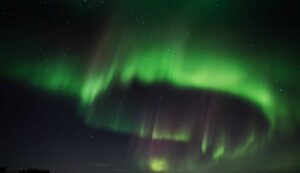
Day Five. The Sky Did Something I Don’t Have Words For Yet.
On my fifth night, I walked out of the dining dome around eleven and the entire northern sky was green. Pale at first, then bright, then moving , long ribbons of light folding into themselves and unfolding again. I had seen the northern lights twice earlier in the week, but only as quiet glows. This was the version everyone hopes for and almost no one gets on their first trip north.
The Ungava coast sits inside the auroral oval, which means on clear nights from late August through early April, the odds of seeing the aurora are very high. Jonathan Grenier, one of the camp’s Inuit co-founders, was quoted in National Geographic saying that on clear nights, guests see the lights almost every evening they’re at camp. I believe him now.
I shot until my fingers stopped working. I have the photos. They don’t capture what it actually felt like, which is the part I’m still trying to put into words.
What I’d Tell Anyone Who’s Thinking About Going
Is It Worth the Price?
A trip to Ungava is not cheap. It sits in the same financial conversation as a private safari or a small-ship Antarctica expedition. What you’re paying for is not luxury in the resort sense. You’re paying for access , a place almost no other operator can take you, run by the Inuit families who live there, with logistics that work in one of the most remote environments in North America.
For the right traveler , someone who has already done Iceland, Alaska, or Patagonia, and is looking for the genuine next step , yes, it is worth it. For someone hoping for a beach with extra glamour, no. The product is honest about what it is, and that honesty is most of what made the trip stay with me.
What to Actually Expect
Expect wind. Constant, shaping wind that becomes part of the soundtrack. Expect to spend long stretches in silence, and to find that you didn’t need a screen as much as you thought. Expect the days to be defined by tide and weather rather than by a printed schedule. Expect to eat better than you have any right to. Expect, also, that wildlife sightings are real wildlife sightings , not a guarantee , and that the people running the camp will tell you this plainly, before you ever pay.
Expect Sasha, the camp dog, to make you feel at home faster than the dome does.
The One Thing I Wish I’d Known Before Flying Up There
Bring a windproof bottom layer. Not just a windproof shell up top , full windproof pants too. I watched a guest spend the week in jeans, and his suffering was visible. The wind doesn’t politely move around fabric; it goes through whatever isn’t designed to stop it. Once you’re properly dressed for the wind, the Arctic stops being uncomfortable and starts being the most peaceful place you’ve ever been.
If you’re planning a trip up north, the team at Ungava Polar Eco-Tours can walk you through everything from the flights to the packing list. You can see the full itinerary and dome details at ungavapolarecotours.com.
Raphaëlle Godbout, guest contributor & photographer. This article was written in partnership with James May and Jonathan Grenier, Inuit co-founders of Ungava Polar Eco-Tours, and edited by AHTO Studio.